Follow Me On Social Media!
Christmas Sugar Cookie Bars
Classic Christmas Sugar Cookie Bars: a buttery sheet-bar topped with smooth vanilla buttercream and red and green sprinkles. Easy to make for parties, exchanges, and gifts.

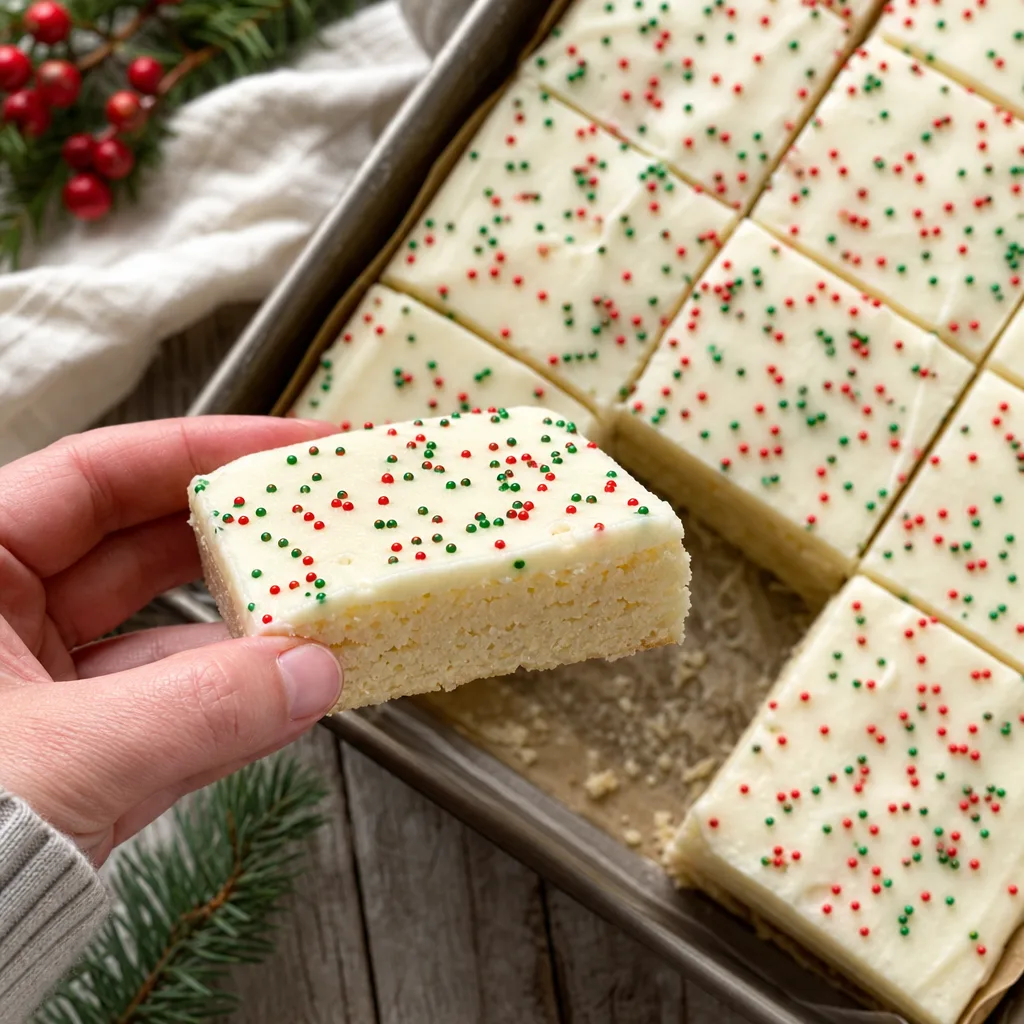
These Christmas Sugar Cookie Bars are a sheet-pan take on classic sugar cookies: tender, buttery, and baked as an easy slab that’s sliced into perfect squares. Topped with a smooth, ivory buttercream and scattered with festive red and green sprinkles, they look like a holiday bakery treat but take a fraction of the effort of rolling and cutting individual cookies. They deliver the familiar vanilla-scented flavor of sugar cookies with a soft, slightly cake-like crumb that holds together beautifully when cut into clean-edged bars.
Make these for cookie exchanges, classroom parties, family dessert platters, or as a make-ahead holiday gift. The method is straightforward—cream the butter and sugar, beat in eggs and vanilla, fold in dry ingredients, bake, frost and sprinkle—and it scales easily if you need extra trays. Because they’re baked in a pan, these bars stay soft and moist longer than many drop cookies, which makes them well suited to preparing a day ahead.
In this recipe I use a straightforward vanilla buttercream to recreate the smooth, pale frosting seen in the inspiration image. The frosting spreads evenly across the cookie slab and sets with a velvety finish, while small red and green nonpareil-style sprinkles add the classic Christmas look and a hint of crunch. The result is bright, nostalgic, and forgiving enough for bakers of any experience level.
Read on for complete ingredient notes, step-by-step instructions, troubleshooting tips, variations for different frosting and flavor options, and thoughtful serving and storage guidance so your bars stay as delightful as the day you baked them.
Why this recipe works
Baking a sugar-cookie-style dough as a single slab eliminates the repetitive steps of rolling, chilling, and cutting individual cookies while preserving the classic flavor of sugar cookies. The increased surface area and consistent thickness help the bars bake uniformly, producing the clean square cuts shown in the inspiration image.
The combination of creamed butter and sugar with a modest amount of leavening yields a tender, slightly cake-like crumb that still holds its shape. Using a stable buttercream for the topping creates the smooth white surface that contrasts with the colorful sprinkles, providing both visual appeal and a pleasant textural contrast between soft interior and crisp nonpareil pieces.
Ingredient notes and substitutions
Butter: Unsalted butter allows you to control the salt level. If you use salted butter, reduce the added salt by about half. For a slightly richer flavor, European-style butter works well but may brown more quickly during baking.
Sweeteners and flour: Granulated sugar gives a classic texture, but you can experiment with part brown sugar for a deeper caramel note—expect a moister crumb and slightly darker color. If substituting gluten-free flour, choose a blend formulated for cookies and cakes to get the best texture.
Troubleshooting common problems
If the center sinks after baking, the bars were likely underbaked or the oven temperature fluctuated. Verify your oven temperature with an oven thermometer and bake until the center springs back slightly and a toothpick shows moist crumbs rather than raw batter.
If frosting becomes runny, refrigerate for 10 to 20 minutes to firm it up. Too-warm frosting often indicates the butter was overheated or the kitchen is very warm; beat in a little extra powdered sugar to thicken if you prefer to keep the frosting spreadable.
Ingredients
- unsalted butter, 1 cup (226 g), softened
- granulated sugar, 1 cup (200 g)
- large eggs, 2
- vanilla extract, 2 teaspoons
- all-purpose flour, 2 1/2 cups (312 g)
- baking powder, 1 teaspoon
- fine salt, 1/2 teaspoon
- whole milk, 2 tablespoons (or as needed)
- powdered sugar (confectioners' sugar), 3 to 3 1/2 cups (360–420 g), divided
- unsalted butter for frosting, 1/2 cup (113 g), softened
- vanilla extract for frosting, 1 teaspoon
- red and green nonpareil or jimmies sprinkles, 1/3 cup (to taste)
- food coloring (optional), a few drops
- butter or nonstick spray for pan, as needed
Instructions
- Preheat the oven to 350°F (175°C). Line a 9×13-inch baking pan with parchment paper leaving an overhang on two sides for easy removal, or lightly grease the pan with butter or nonstick spray. (i14)
- In a large mixing bowl or the bowl of a stand mixer fitted with the paddle attachment, cream 1 cup softened unsalted butter with 1 cup granulated sugar on medium speed until pale and fluffy, about 2 to 3 minutes. Scrape down the sides of the bowl as needed. (i1, i2)
- Add 2 large eggs one at a time, mixing briefly after each addition until incorporated, then stir in 2 teaspoons vanilla extract. Mix just until combined; avoid overbeating. (i3, i4)
- In a separate medium bowl whisk together 2 1/2 cups all-purpose flour, 1 teaspoon baking powder, and 1/2 teaspoon fine salt. Gradually add the dry ingredients to the butter mixture on low speed, mixing until a soft dough forms. If the dough feels very stiff, add 1 tablespoon of whole milk to help bring it together. (i5, i6, i7, i8)
- Turn the dough into the prepared 9×13-inch pan. Using oiled fingers, an offset spatula, or a piece of parchment, press the dough evenly into the pan so it reaches all corners and the surface is as flat as possible. The dough will be about 1/2 to 3/4 inch thick. (i14)
- Bake in the preheated oven for 18 to 22 minutes, or until the edges are lightly golden and the center is set but still soft to the touch. A toothpick inserted into the center should come out with a few moist crumbs but not raw batter. Rotate the pan halfway through baking for even color if your oven has hot spots. (no ingredients)
- Remove the pan from the oven and allow the bars to cool completely in the pan on a wire rack, about 45 to 60 minutes. Cooling fully before frosting prevents the buttercream from melting and sliding. (no ingredients)
- Make the buttercream while the bars cool. In a mixing bowl beat 1/2 cup softened unsalted butter until smooth. Gradually add 3 cups powdered sugar, 1 teaspoon vanilla extract, and 1 to 2 tablespoons whole milk, beating on low until combined and then on medium-high until the frosting is smooth and spreadable. If you prefer a stiffer frosting, use more powdered sugar; for a thinner spread, add a little more milk. Optionally tint the frosting with a few drops of food coloring to a pale ivory or leave it white. (i9, i10, i11, i8, i13)
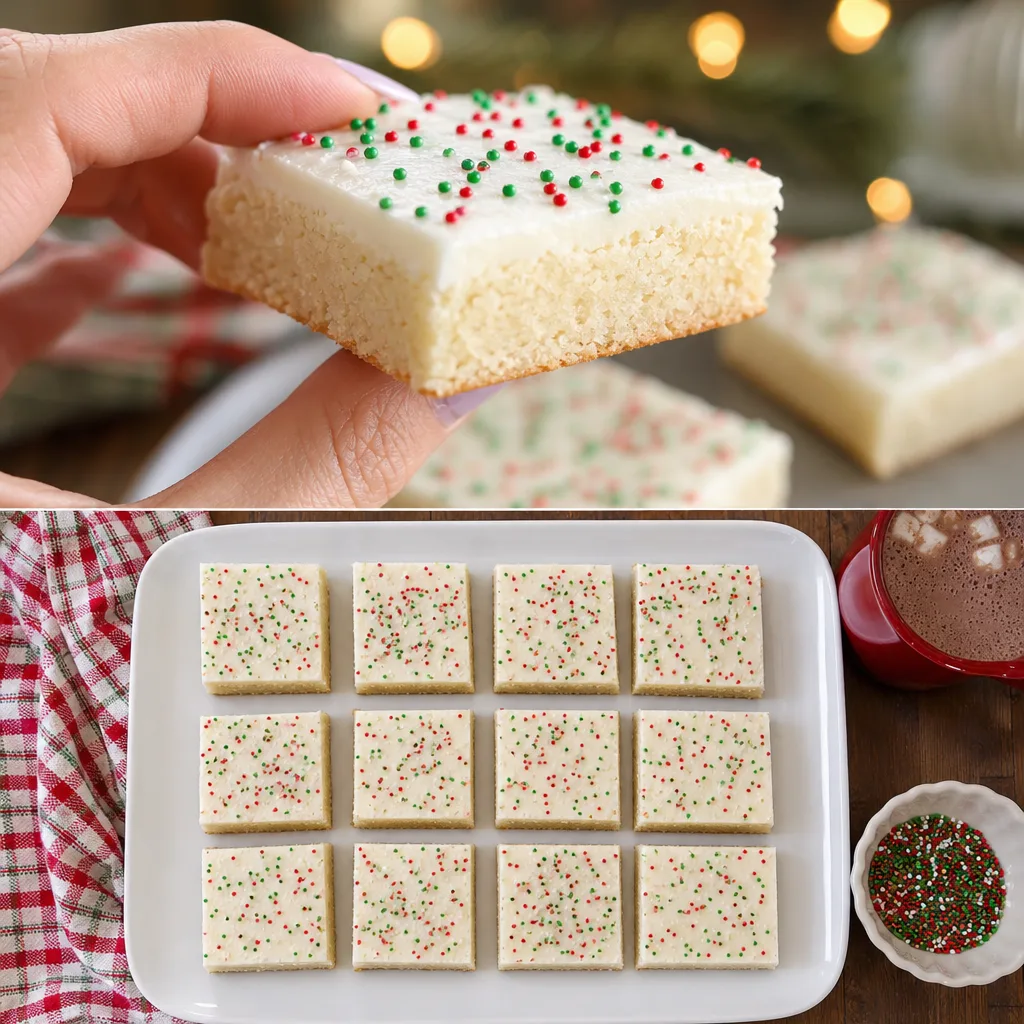
- Once the bars are completely cool, spread the buttercream evenly over the surface using an offset spatula or a knife, finishing with smooth, even strokes to create the clean, bakery-style top seen in the inspiration. Work quickly but gently to avoid tearing the surface. (i9)
- Immediately sprinkle 1/3 cup red and green nonpareil or jimmies sprinkles across the frosted surface, pressing very lightly so a few sprinkles stick into the buttercream while most remain on top. If you want a denser sprinkle coverage, add more to taste. (i12)
- Chill the frosted slab in the refrigerator for 15 to 20 minutes to set the buttercream slightly, which makes cutting cleaner. After chilling, use a sharp chef’s knife wiped clean between cuts to slice the slab into 24 squares. Warm the knife under hot water and dry it, or wipe with a warm towel between passes to maintain smooth edges. Return any unserved bars to the refrigerator for storage. (no ingredients)
Pro Tips
- Room-temperature butter and eggs incorporate more easily and create a lighter crumb. If butter is cold, microwave in 5-second bursts until just softened, not melted.
- For the smoothest frosting, sift powdered sugar before measuring to remove lumps and ensure even mixing.
- To get perfectly square cuts, chill the frosted slab before slicing and wipe the knife clean between each cut; warming the knife with hot water helps make smoother edges.
- If you prefer a crisper edge, bake 1 to 2 minutes longer, checking the center with a toothpick to prevent overbaking.
- If the dough cracks while pressing into the pan, press small pieces to fill gaps and then smooth with a parchment-topped rolling motion to create an even surface.
Variations
- Lemon-scented bars: Replace 1 teaspoon of vanilla with 2 teaspoons fresh lemon zest and 1 tablespoon lemon juice in the dough; add 1/2 teaspoon lemon zest to the frosting and thin with a splash of lemon juice for a bright citrus finish.
- Cream cheese frosting: Swap the buttercream for a tangy cream cheese frosting by beating 4 ounces softened cream cheese with 1/4 cup softened butter, then gradually adding 2 to 2 1/2 cups powdered sugar and 1 teaspoon vanilla. Spread when smooth.
- Chocolate-dipped edges: After cutting the bars, temper or melt 6 ounces of dark or semi-sweet chocolate and dip two opposite edges of each square into the chocolate; let set on parchment.
- Sparkling sugar topping: Instead of nonpareils, brush the fresh-frosted surface with a thin layer of corn syrup or light honey and sprinkle with colored sanding sugar for a glittering finish.
Serving Suggestions
- Serve at room temperature on a festive platter with hot cocoa or mulled cider to complement the sweet, buttery flavor.
- Package three or four bars in a clear box tied with ribbon as a holiday neighbor or teacher gift; include a napkin for easy snacking.
- Arrange bars on dessert tables alongside gingerbread and peppermint treats to add a classic cookie-bar option for guests who prefer vanilla flavors.
- Cut bars slightly smaller and serve as part of a cookie tasting tray paired with different frostings and sprinkle styles so guests can try variations.
Make-ahead and transport tips
For efficient hosting, bake the slab the day before and store it tightly wrapped at room temperature; frost on the day you plan to serve. This keeps the frosting looking freshly spread and the sprinkles crisp.
When transporting frosted bars, place them in a shallow box with parchment lining and a single layer; add a tight-fitting lid or cover with plastic wrap to prevent dust and settling. If stacking is necessary, separate layers with parchment to avoid smudging the frosting.
Storage and Reheating
Store unfrosted bars tightly wrapped at room temperature for up to 2 days. Frosted bars keep well in an airtight container in the refrigerator for 5 to 7 days; bring to room temperature before serving for best texture. You can freeze unfrosted bars wrapped securely for up to 3 months; thaw in the refrigerator overnight before frosting. Frosted bars can be flash-frozen on a tray, then stacked with parchment between layers in an airtight container and kept frozen for up to 2 months. Thaw in the refrigerator and bring to room temperature before serving.

Christmas Sugar Cookie Bars
Buttery sugar cookie sheet bars topped with vanilla buttercream and festive red and green sprinkles. Simple to make, easy to slice, and ideal for holiday gatherings.
Ingredients
Equipment
Method
- Preheat oven to 350°F (175°C). Line a 9×13-inch pan with parchment or lightly grease it with butter or nonstick spray.
- Cream 1 cup softened unsalted butter and 1 cup granulated sugar until pale and fluffy, about 2 to 3 minutes, scraping the bowl as needed.
- Add 2 large eggs one at a time, mixing briefly after each addition, then beat in 2 teaspoons vanilla extract until combined.
- Whisk together 2 1/2 cups all-purpose flour, 1 teaspoon baking powder, and 1/2 teaspoon fine salt in a separate bowl. Gradually add the dry ingredients to the wet mixture and mix on low until a soft dough forms; if too stiff, add 1 tablespoon of whole milk.
- Press the dough evenly into the prepared pan using lightly oiled fingers, an offset spatula, or parchment to smooth the surface so the dough reaches the corners.
- Bake for 18 to 22 minutes until the edges are lightly golden and a toothpick in the center comes out with moist crumbs but not raw batter. Rotate the pan halfway through if needed.
- Cool the baked slab in the pan on a wire rack until completely cool, about 45 to 60 minutes, before frosting so the buttercream does not melt.
- Make the buttercream by beating 1/2 cup softened butter until smooth, then gradually adding 3 cups powdered sugar, 1 teaspoon vanilla, and 1 to 2 tablespoons milk. Beat until light and spreadable; add more powdered sugar to thicken or more milk to thin. Optionally tint with a few drops of food coloring.
- Spread the buttercream evenly over the cooled slab with an offset spatula for a smooth top.
- Sprinkle 1/3 cup red and green sprinkles over the frosted surface immediately, pressing very lightly so a few adhere to the frosting.
- Chill the frosted slab for 15 to 20 minutes to set the frosting. Use a sharp knife warmed under hot water and wiped dry between cuts to slice into 24 squares with clean edges.
Notes
For best results, allow bars to cool completely before frosting.
Adjust powdered sugar to control frosting consistency depending on humidity and room temperature.
Frequently Asked Questions
Can I make these bars gluten-free?
Yes. Replace the all-purpose flour with a 1:1 gluten-free baking flour blend that contains xanthan gum. Because blends vary, watch the dough’s consistency and add a tablespoon or two of milk if the mixture seems too dry. Baking time should be similar, but check for doneness early.
How can I make the frosting dairy-free?
Substitute the butter in the frosting with a dairy-free stick butter or a margarine that measures like butter, and use a plant-based milk such as almond or oat. The texture will be slightly different but still spreadable; chill briefly to set.
Why did my bars crack while pressing the dough into the pan?
Cracking usually means the dough is slightly dry or stiff. Use clean, lightly oiled fingers or lay a sheet of parchment over the dough and press with a rolling pin to smooth it. If needed, add 1 tablespoon of milk to the dough and knead gently to bring it together before pressing.
Can I make these ahead for a party?
Absolutely. Bake the slab and store unfrosted bars wrapped at room temperature for up to 48 hours, then frost just before serving. If you need longer storage, freeze unfrosted bars and frost after thawing. Alternatively, fully frost the bars and refrigerate; they will stay fresh for up to a week.
How do I get the frosting as smooth as in bakery photos?
Start with room-temperature, well-beaten frosting so there are no lumps. Use an offset spatula and swipe in even strokes, smoothing the surface from the center outward. Chill briefly to firm the frosting and, if desired, lightly warm the spatula under hot water and dry it to make a final smoothing pass for a glossy finish.