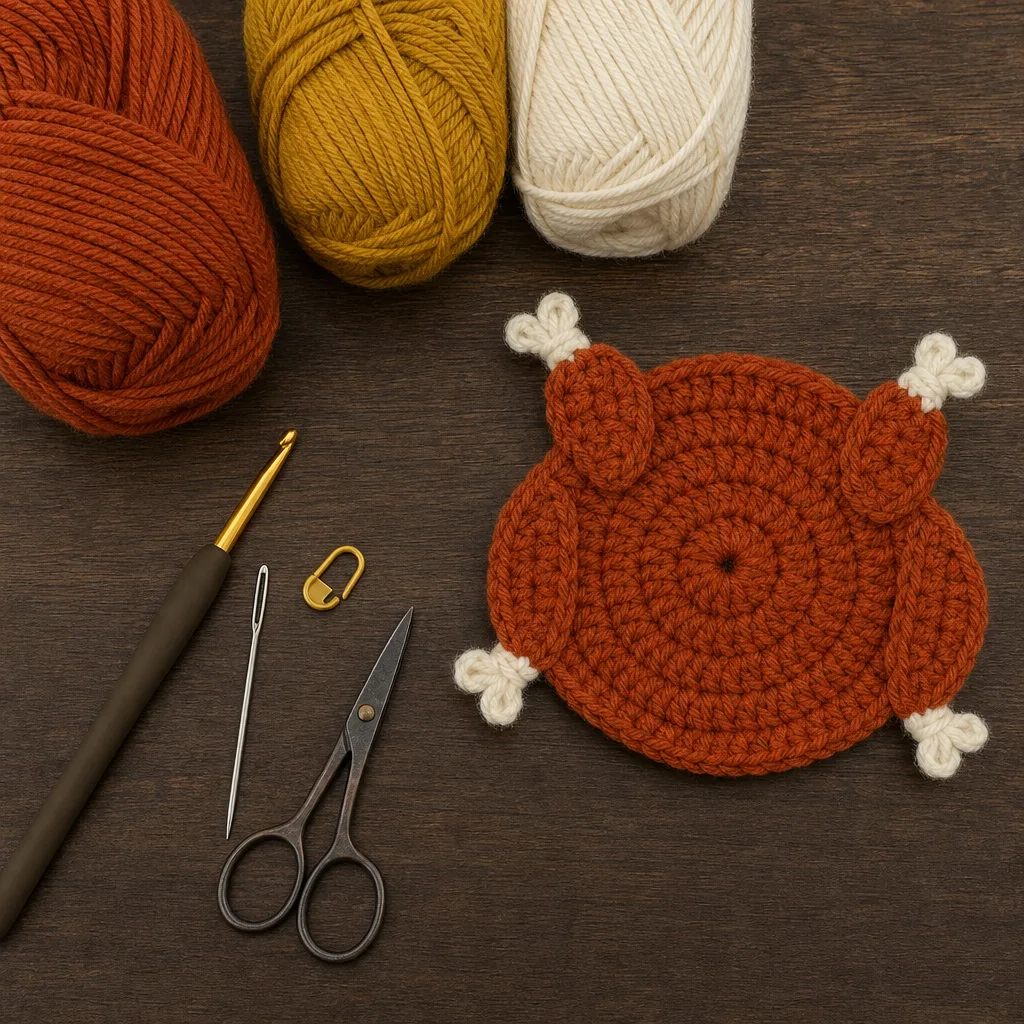
Ingredients
Equipment
Method
- Prepare materials and gauge: Gather burnt orange (main color), mustard (accent), off-white (bone), dark brown (optional) yarns and a 4.0 mm crochet hook. Place a stitch marker where helpful and have a yarn needle and scissors ready. Aim for a finished coaster approximately 10–12 cm (4–4.5 in) across; adjust hook if needed to match size expectations.
- Magic ring and round 1: With burnt orange yarn, make a magic ring. Chain 1 (does not count as a stitch), then work 8 single crochets (sc) into the ring. Pull the tail to close the ring. Place a stitch marker in the first stitch to mark the start of the round.
- Round 2: Work 2 sc in each stitch around (increase in every stitch) — 16 sc total. Move the stitch marker up to the new round’s first stitch.
- Round 3: *1 sc in next stitch, 2 sc in next stitch* — repeat around (24 sc total).
- Round 4: *1 sc in each of next 2 stitches, 2 sc in next stitch* — repeat around (32 sc total).
- Round 5: *1 sc in each of next 3 stitches, 2 sc in next stitch* — repeat around (40 sc total). This round should produce a flat circle; check for curling. If the circle begins to ruffle instead of lying flat, stop increasing and proceed to working a plain round.
- Rounds 6–7 (or until desired diameter): Work 1 sc in each stitch around for two rounds (or work single crochet rounds until the diameter reaches 10–12 cm). Keep the piece flat by checking frequently and adjusting the number of plain rounds if needed.
- Form the base scallops: Switch to mustard/golden yarn. Join with a slip stitch at the front loop of any stitch, chain 1, *work (sc, hdc, dc, hdc, sc) in the same stitch to create a scallop; skip 2 stitches; slip stitch in next stitch* — repeat around to produce evenly spaced scallops around the outer edge. Aim for 8 scallops; if spacing is off, adjust by skipping only 1 stitch between scallops or shifting placement slightly. Finish the round with a slip stitch and fasten off. Weave in tails.
- Mark leg placement: Using burnt orange, identify four evenly spaced points around the edge where the ‘drumstick’ shapes will attach. Think of placing them at roughly the 12, 3, 6 and 9 o’clock positions; move the stitch marker as needed to mark the attachment points.
- Crochet each drumstick (make 4): Attach burnt orange yarn at a marked point with a slip stitch. Chain 2, then work the following into the next few free loops to form a small rounded nub: 6 sc into the first chain space (forming a small rounded piece), then slip stitch back into the base to secure. For a slightly longer leg, chain 1 after the nub and slip stitch back into the base again. Fasten off leaving a tail for weaving. Repeat for the remaining three legs.
- Add bone details: Thread off-white yarn onto the yarn needle. For each drumstick, bring the off-white yarn through the outermost edge of the nub and create a small loop to represent the bone end: wrap the yarn once or twice and stitch it to the nub securely, then take the needle back through the coaster body and knot on the underside. Trim the bone tails short or leave tiny tassels if preferred. Use dark brown yarn sparingly to embroider tiny roast marks on the drumsticks if desired.
- Finish and block: Weave all tails into the coaster so they’re hidden. Lightly spray the coaster with a fabric stiffener or light spray starch if you want a firmer, more coaster-like finish; press gently with your hand to smooth. Lay flat to dry completely.
- Optional edging touch-up: If the scallops or leg attachments look uneven, use a round of slip stitches in burnt orange around the outermost edge to tidy the joins. Work evenly spaced slip stitches, then fasten off and weave in the ends.
- Care instructions: To wash, hand-wash gently in cool water with mild soap and lay flat to dry. Avoid machine washing or high heat drying to preserve shape and color. If you used starch, reapply after washing for stiffness.
Notes
This item is decorative and functional as a coaster; it contains no stuffing and is not edible.
Gauge and final size can be adjusted by switching hook size or yarn weight.
Pattern is written in US crochet terms.